
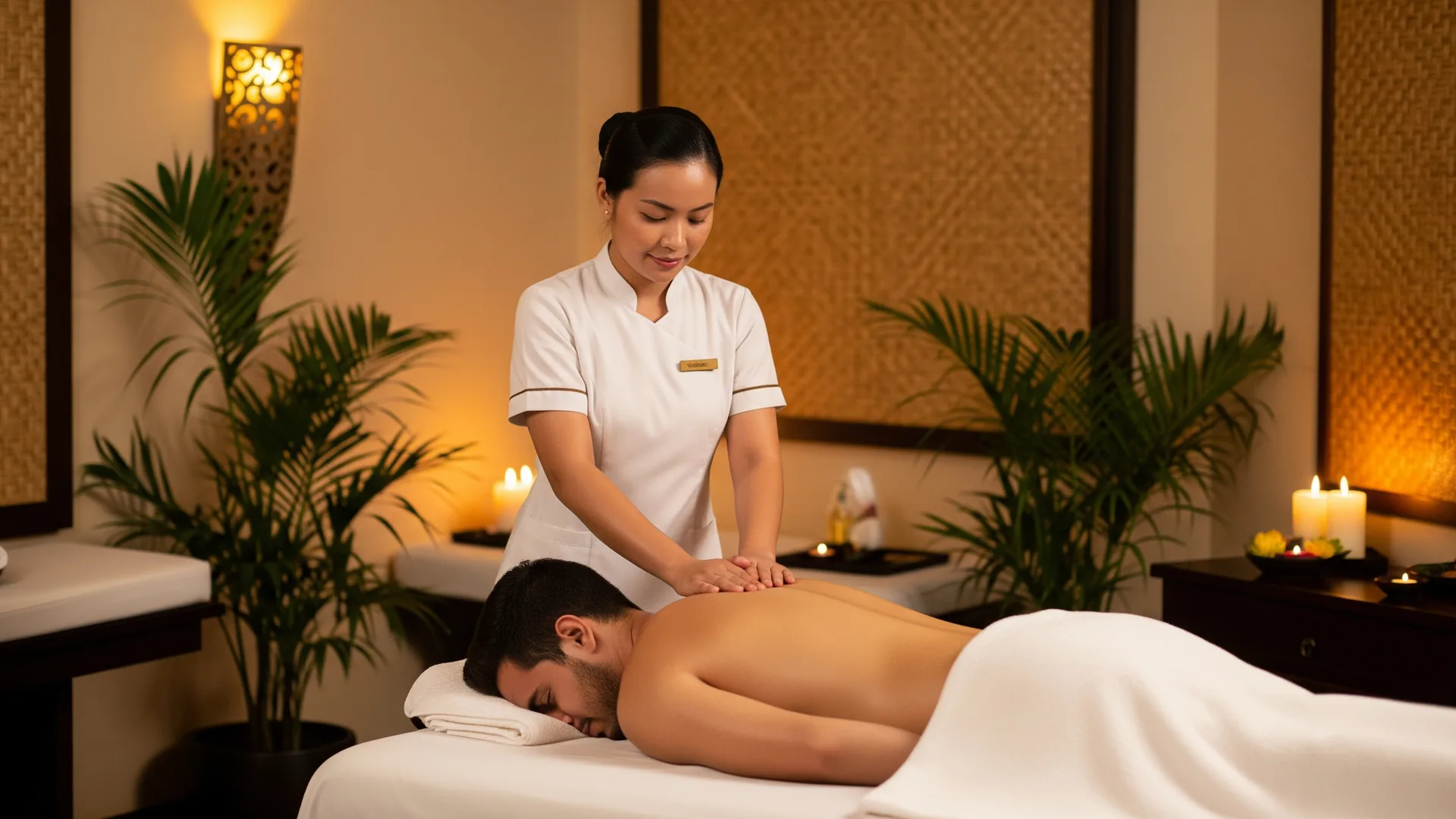
There is a moment, somewhere between the warm oil settling into your skin and the rhythm of a therapist’s hands finding the tension you didn’t know you were carrying, when something shifts. It isn’t only your muscles that release. Something quieter, deeper, lets go too. In Bali, this is not an accident. It is the entire point. The balinese wellness philosophy body mind soul is not a marketing concept; it is a centuries-old understanding that a human being cannot be healed in parts. To tend the body is to tend the mind. To tend the mind is to tend the soul. These three are one.
More Than a Massage: What Balinese Wellness Philosophy Really Means
In much of the Western world, a spa visit is a transaction. You arrive tense, you pay for an hour, you leave a little looser. Wellness is parcelled into categories, the gym for the body, therapy for the mind, perhaps a Sunday church or meditation app for something vaguely spiritual. Each lives in its own lane.
Balinese culture has never understood wellness this way. Here, caring for the body is inseparable from caring for the mind and soul, not as a philosophy people choose, but as the water they swim in. Every act of care, from cooking a family meal to tending a garden, is understood as an expression of harmony with the universe. Scholars of Balinese Hinduism, from Clifford Geertz to I Wayan Budi Utama, have long noted that the sacred and the everyday are not two different domains in Balinese life, they are the same domain, experienced continuously.
This is where healing meets ritual in Seminyak: not in a spa menu, but in a way of seeing the world.
Tridhatu Balance: The Balinese Framework of Body, Mind, and Soul
The Balinese holistic healing tradition draws on a foundational concept: tridhatu, the three-layered understanding of the self. Think of it as a map, not of symptoms, but of the whole person. True health, in this framework, requires all three layers to be in harmony. Tend only one and you are, at best, half-healed.
The Three Dimensions of the Self
The first layer is the physical body, stula sharira, the tangible, sensory self. Muscles, bones, breath, digestion. This is the layer most Western wellness culture addresses first, and often last.
The second is the conscious mind: thought, emotion, memory, and intention. Balinese tradition understands the mind not as a brain function but as a field of energy that shapes physical experience. Anxiety tightens the chest. Grief stiffens the shoulders. The body keeps the record of the mind’s story.
The third is the spirit or life force, known variously as prana or atman, the animating essence that connects the individual self to something larger. In Balinese thought, this is not a metaphor; it is as real and manageable as blood pressure.
Bali’s three-stage wellness philosophy, release, restore, rebalance, maps onto tridhatu naturally, which is why it feels so intuitive to those who experience it.
Why Imbalance in One Layer Affects All Three
Tridhatu balance is not a static state. It is dynamic, relational, and easily disrupted. A physical injury, a bad back, a bout of illness, creates mental anxiety, which in turn dims the spirit. Conversely, a period of grief or spiritual disconnection manifests as physical exhaustion, headaches, a body that simply will not cooperate.
Balinese holistic healing takes this seriously. A remedy aimed only at the back pain misses the grief that may be holding it in place. This is why traditional treatments in Bali address all three layers simultaneously, through touch, through intention, through ritual, and through the use of plant-based medicines chosen for their effect on the whole system, not just the symptom.
The Role of the Spirit in Balinese Holistic Healing
Sekala and Niskala: The Seen and Unseen Worlds
To understand Balinese spiritual wellness, you need two words: sekala and niskala. Sekala is the visible, physical realm, everything that can be seen, touched, measured. Niskala is the invisible, spiritual realm, the world of energy, ancestors, intention, and divine force.
In Balinese Hindu cosmology, these two worlds are not separate. They overlap, continuously. Health lives in the relationship between them. When sekala and niskala are in balance, life flows. When they fall out of alignment, the disruption surfaces first as unease, then as illness, then as deeper suffering.
This belief shapes daily life in ways that are immediately visible to any visitor. Every morning across Bali, canang sari offerings, small palm-leaf baskets woven by hand and filled with flowers, incense, and rice, are placed at thresholds, altars, and crossroads. This ritual, documented in detail by cultural anthropologists including Miguel Covarrubias and unbroken across centuries, is not superstition. It is maintenance. A daily act of keeping the relationship between the seen and unseen worlds well-tended, the way you might water a garden.
For healing, this means that a physical symptom is always read in relation to its invisible dimension. Something in the spiritual field may need rebalancing before the body can fully recover.
How Balinese Healers and Spa Traditions Bring This Philosophy to Life
The Balian: Bali’s Traditional Healer
The balian, Bali’s traditional healer, does not treat symptoms in isolation. A balian is consulted not merely for physical ailments but for emotional distress, spiritual disconnection, and family disharmony, reflecting a centuries-old understanding that these forces are inseparable. A person who cannot sleep may need a plant remedy, yes, but the balian may also identify a disrupted relationship with an ancestor, or an energetic imbalance that no pharmaceutical addresses.
The balian works through several means: herbal medicine, prayer, energy work, and ritual, often all in a single consultation. The patient is seen as a whole person embedded in family, community, and cosmos. The treatment addresses all of it.
This tradition is the root from which all authentic Balinese wellness practice grows.
From Sacred Ritual to Spa Treatment
The Balinese spa treatments a guest experiences today, warm oils pressed into the skin with long gliding strokes, acupressure applied to energy points, rhythmic skin-rolling techniques, are not decorative wellness theatre. They are a direct descendant of the balian’s work, translated into a form that a visitor can receive without the initiatory context of traditional healing.
Traditional Balinese massage uses precisely this combination: flowing strokes to ease muscular tension, acupressure on energy points to stimulate the flow of prana through the body’s energetic channels, and skin rolling to awaken the surface layer of the body and encourage circulation at a cellular level. The botanical scrubs, ground rice, turmeric, frangipani, are chosen because these plants have been used in Balinese healing for generations, each carrying its own energetic and medicinal properties. The floral bath that closes many Balinese treatments is a ritual of release and renewal, not simply a pleasant soak.
When each element is understood this way, a treatment stops feeling like a service and starts feeling like what it is: a ceremony.
Why Balinese Holistic Healing Differs from Western Wellness Models
Western wellness culture is genuinely evolving. There is growing interest in integrative medicine, somatic therapy, and the connection between mental state and physical health. Ancient Eastern frameworks, Ayurveda, Traditional Chinese Medicine, and increasingly Balinese holistic healing, are informing how progressive wellness destinations around the world design their offerings.
But Balinese culture has not borrowed this understanding from anywhere. It has held it for centuries, unbroken.
The key difference is one of starting assumption. Western wellness models typically begin with the body as a mechanical system and work outward, treating the part, then perhaps the whole. The mind body spirit Bali spa tradition begins from integration and works inward. The body, mind, and spirit are already one; the healer’s task is to restore the harmony that is their natural state.
This means that a guest at a Balinese-philosophy spa is not receiving a sequence of isolated services. They are moving through a single, coherent experience designed to restore balance across all three dimensions at once. That is a fundamentally different proposition, and one that Western wellness, for all its innovation, is still working towards.
Experiencing Balinese Wellness Philosophy in Seminyak
To experience the balinese wellness philosophy body mind soul in practice is to arrive differently, not as a consumer choosing a service, but as someone ready to be restored.
Imagine stepping into a space where the scent of frangipani and warm sandalwood already signals to your nervous system that something is shifting. Where the therapist’s hands work not just to smooth away knots but to listen, to find where the body is holding, where the breath won’t quite reach, where the energy has gone still. Where the ritual of preparation, the silence, and the intentional closing of a treatment are as much a part of the healing as the technique itself.
This is the experience that Balinese spa treatments for stress relief are built to offer when they are grounded in authentic philosophy, not simply relaxation, but genuine integration.
At Essential Health & Rejuvenation Spa in Seminyak, every treatment is designed with this integrated philosophy in mind, addressing physical tension, mental stillness, and the restorative power of intentional ritual in a single, coherent experience. Whether you visit us at our sanctuary in Seminyak Square or invite us to you through our Essential On Call in-villa massage in Bali’s Seminyak service, the philosophy travels with us.
We invite you to explore our full treatments menu and find the experience that calls to you. Body, mind, and soul, we are ready to welcome all three.