
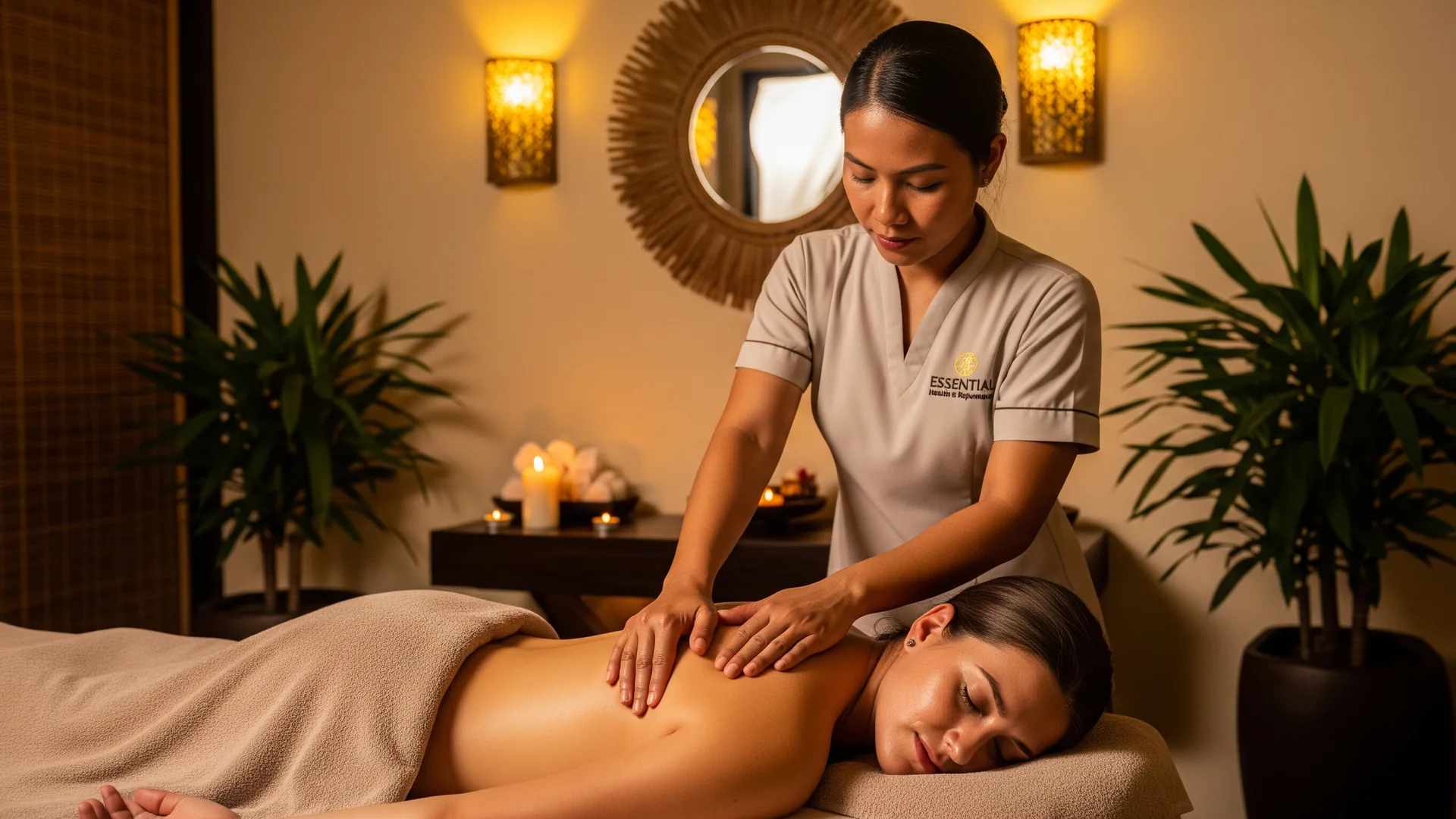
There is a particular kind of tension that no amount of gentle stroking will touch. It sits deep in the trapezius after eight hours hunched over a laptop. It lodges between the shoulder blades after a long-haul flight. It knots through the shoulders after a season of paddling out at dawn. A deep tissue massage in Seminyak is built for exactly this kind of tension, not as a luxurious add-on, but as a considered, therapeutic response to a real physical problem.
At Essential, we treat deep tissue work as a ritual with a purpose. It is slower and more deliberate than a generic spa menu item ever lets on, and more honest about what your body actually needs. Before we go further, it helps to understand what this technique actually does. That understanding is what allows you to choose it with confidence rather than guesswork.
What Is Deep Tissue Massage, Really?
Deep tissue massage works through the layers of muscle and the fascia surrounding it, rather than simply gliding over the surface. Where a lighter massage soothes the skin and superficial muscle, deep tissue work uses slower, more sustained strokes with firmer pressure to reach the deeper muscle fibres and the connective tissue that wraps around them.
This matters because chronic tension often isn’t sitting at the surface. Repetitive posture, old injuries, and stress tend to settle into deeper muscle layers over time, creating knots and areas of restriction that a lighter touch can’t release. A skilled therapist works gradually into these areas and lets the tissue soften rather than forcing it. That’s what separates a considered deep tissue session from simply pressing harder.
How Deep Tissue Differs from a Balinese Massage
A traditional Balinese massage is built around flow. It uses long, rhythmic strokes, gentle stretching, and acupressure to balance energy and encourage overall relaxation. It’s a beautiful ritual in its own right, and it remains one of Seminyak’s premium massage traditions for good reason.
Deep tissue massage has a different job. It isn’t primarily about balancing energy or inducing a floaty sense of calm, though that often happens too. It’s about addressing a specific, physical problem, a stiff neck, a locked-up lower back, shoulders that never quite relax, with targeted, sustained pressure. Think of a Balinese massage as restoring harmony, and deep tissue as resolving a particular knot. Many guests benefit from understanding the broader health benefits of massage therapy before deciding which approach suits them.
Who Deep Tissue Massage in Seminyak Is Really For
Not every guest needs firm pressure, and that’s fine. But for certain people, deep tissue massage isn’t a luxury. It’s close to a necessity.
Desk-Bound Digital Nomads and Screen Fatigue
Bali’s coworking spaces are full of people who spend their days curled over laptops, and Seminyak has more than its share of them. That posture, held for hours, pulls the shoulders forward and locks tension into the neck and upper back. A digital nomad hunched over a laptop for eight hours a day carries tension differently to a surfer with tight shoulders from paddling, and the therapist’s approach at Essential reflects that distinction.
For remote workers, deep tissue massage targets exactly the areas screen work aggravates most: the base of the skull, the upper trapezius, and the muscles running along the shoulder blades. If work stress is a recurring pattern rather than a one-off, it’s worth thinking about managing work stress as a digital nomad in Bali as part of a wider rhythm, with regular bodywork as one piece of that routine.
Surfers, Gym-Goers, and Chronic Tight Shoulders
Guests who surf, lift, or train regularly carry a different kind of tension. Paddling out repeatedly tightens the shoulders and upper back; heavy lifting can leave the lower back and glutes chronically tight. Deep tissue massage works well here because it’s precise enough to target the specific muscle groups under strain, easing the tightness that builds session after session.
Jet-lagged long-haul arrivals often hold tension in the neck and lower back from hours in a cramped seat. It’s one of the most common reasons guests request deep tissue work in their first days in Bali. If that describes you, deep tissue can be a genuinely useful way to reset before the rest of the trip begins.
That said, deep tissue isn’t right for everyone. If you have a recent injury, very sensitive skin, or you’re simply new to massage and unsure about firm pressure, a gentler treatment is the wiser first step. There’s no need to prove anything to a therapist. Essential will always guide you toward the right pressure for your body, not the other way around.
What to Expect During a Session at Essential
At Essential’s Seminyak Square spa, therapists begin every deep tissue session with a brief conversation about problem areas, posture habits, and pain history before adjusting pressure to suit the individual. This isn’t a formality. It genuinely shapes how the session unfolds, because a guest carrying laptop-related neck tension needs a different route through the body than a guest recovering from a heavy training week.
Once the treatment begins, the pace is unhurried. Your therapist works through the muscle layers gradually, checking in on pressure as they go rather than assuming more is always better. Deep tissue work can feel intense, particularly in areas that have been tight for a long time, but it should never tip into sharp or unbearable pain. If something feels wrong rather than simply firm, say so. A good therapist will adjust immediately.
The atmosphere stays calm and reassuring throughout, in keeping with the way Essential approaches every treatment: as a considered ritual, not a rushed transaction.
Aftercare: Hydration and Recovery Following Deep Tissue Work
What happens after a deep tissue massage matters almost as much as the session itself. Therapists generally advise drinking extra water in the hours afterward, since firmer pressure works through muscle layers that can leave tissue feeling tender until it settles. Water helps flush the byproducts of that deeper tissue work through the body.
Gentle movement, a slow walk, some light stretching, tends to help more than complete stillness, because it keeps circulation moving through the treated muscles. This is not the day for an intense gym session or a long surf. Give the muscles time to settle rather than immediately testing them again.
Some mild tenderness in the day or two afterward is normal, similar to the feeling after a new workout. It’s a sign the tissue has been genuinely worked, not a cause for concern. This is what separates deep tissue massage from a purely relaxing treatment: the benefit builds over the following days as the muscle recovers, rather than fading the moment you step off the table.
Deep Tissue vs Balinese vs Sports Massage: Choosing at Essential
With three strong options on the table, it helps to choose based on what you actually need rather than what sounds most indulgent.
If your goal is calm, balance, and a sense of full-body relaxation, a Balinese massage is the natural choice. If you’re carrying specific, chronic tension, screen-related neck stiffness, a tight lower back, shoulders that never fully release, deep tissue massage is built for exactly that. And if you’re training seriously, recovering from a specific athletic strain, or preparing for a big physical push, it’s worth reading how sports massage supports athletic recovery, since that modality is tuned more precisely to performance and recovery than either of the other two.
Many guests at Essential move between all three depending on the season of their life, which is exactly how they should be used: as tools matched to a particular need, not fixed labels on a menu. The full treatments menu at Essential sets all three side by side, which makes comparing them straightforward before you book.
Booking Deep Tissue Massage: In-Spa or Essential On Call
However you choose to experience it, deep tissue massage at Essential is available in two ways, and both are treated with the same care.
Visiting Essential at Seminyak Square
The spa at Seminyak Square is a dedicated wellness environment, ideal for guests who want the full, uninterrupted ritual of a spa visit. It’s a natural choice for anyone staying in or around Seminyak, Petitenget, Oberoi, Double Six, Legian, Kerobokan, Batu Belig, Berawa, Canggu, or Umalas, and plenty of guests travel in from Kuta, Sanur, Jimbaran, Uluwatu, and Nusa Dua specifically for a longer treatment here.
Booking In-Villa via Essential On Call
For guests who would rather not leave their accommodation, Essential On Call brings the same deep tissue technique to villas and hotel rooms across Seminyak, Canggu, and Uluwatu, so travellers can recover without leaving their accommodation. The service covers a wide zone, from the core area around Seminyak, Petitenget, Legian, Kuta, Kerobokan, Umalas, Berawa, Canggu, Pererenan, and Batu Bolong, through to Sanur, Jimbaran, Nusa Dua, Uluwatu, Bingin, Pecatu, Ungasan, and selected parts of Tabanan. It’s also a natural fit for group settings: villas, private residences, hotels and resorts, retreats, bridal parties, corporate wellness programmes, and spa parties, all built around the same unhurried, therapeutic approach. For a closer look at how this works in practice, professional in-villa massage treatments in Seminyak walks through what an in-villa session involves.
Whichever setting suits you, booking your spa appointment online takes only a few minutes. If your shoulders have been carrying more than they should, or your neck has forgotten what it feels like to rest, let us treat that tension properly. We invite you to book a deep tissue massage at Essential, in Seminyak Square or wherever you’re staying, and give your body the ritual it has been asking for.